Settings and search
Nowa szczerość
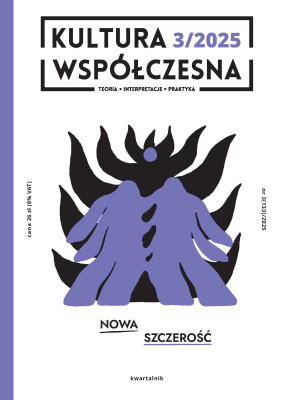
Table of contents
New sincerity
doi.org/10.26112/kw.2025.133.01
doi.org/10.26112/kw.2025.133.02
The postmodern years of plenty, pastiche, and parataxis are over. In fact, if we are to believe the many academics, critics, and pundits whose books and essays describe the decline and demise of the postmodern, they have been over for quite a while now. But if these commentators agree the postmodern condition has been abandoned, they appear less in accord as to what to make of the state it has been abandoned for. In this essay, we will outline the contours of this discourse by looking at recent developments in architecture, art, and film. We will call this discourse, oscillating between a modern enthusiasm and a postmodern irony, metamodernism. We argue that the metamodern is most clearly, yet not exclusively, expressed by the neoromantic turn of late associated with the architecture of Herzog & de Meuron, the installations of Bas Jan Ader, the collages of David Thorpe, the paintings of Kaye Donachie, and the films of Michel Gondry.
Key words: metamodernism, New Romanticism, structure of feeling, contemporary aesthetics
Bibliography
Avramenko, Richard. „Bedeviled by boredom: A Voegelinian reading of Dostoevsky’s possessed”. Humanitas 17, 1–2 (2004).
BAK, Press Statement Vectors of the Possible. http://www.bak-utrecht.nl/?click.
Berlin, Isaiah. Korzenie romantyzmu. Tłum. Anna Bartkowicz. Poznań: Zysk i S-ka, 2004.
Campbell-Johnston, Rachel. „Altermodern: Tate Triennial 2009 at Tate Britain”. The Times, 2 marca 2009.
Coulson, Amanda. „Ragnar Kjartansson”. Frieze 102 (2006). http://www.frieze.com/issue/review/ragnar_kjartansson/.
Eshelman, Raoul. Performatism, or the End of Postmodernism. Aurora: Davies Group, 2008.
Eshelman, Raoul. „Performatism, or what comes after postmodernism: New architecture in Berlin”. Art-Margins, kwiecień 2002. http://www.artmargins.com/index.php/archive/322-performatism-or-what-comes-after-postmodernism-new-architecture-in-berlin.
Fukuyama, Francis. „The end of history and the last man”. New York Free Press 3 (1992).
Galerie Tanja Wagner. Press Statement The Door Opens Inwards, wrzesień 2010. http://www.tanjawagner.com.
Hassan, Ihab H. The Postmodern Turn: Essays on Postmodernism and Culture. Columbus: Ohio State University Press, 1987.
Heiser, Jörg, red., Romantic Conceptualism. Bielefeld: Kerber, 2008.
Hutcheon, Linda. The Politics of Postmodernism. New York: Routledge, 2002.
Jameson, Fredric. Postmodernism, or The Cultural Logic of Late Capitalism. Durham: Duke University Press, 1991.
Jencks, Charles. The Language of Post-Modern Architecture. London: Academy Editions, 1991.
Kant, Immanuel. „Idea powszechnej historii w aspekcie kosmopolitycznym”. Tłum. Mirosław Żelazny. W: Immanuel Kant. Dzieła zebrane. T. 6. Toruń: Wydawnictwo Naukowe UMK, 2011.
Kirby, Alan. Digimodernism: How New Technologies Dismantle the Postmodern and Reconfigure our Culture. New York: Continuum, 2009.
Lipovetsky, Gilles. Hypermodern Times. Cambridge: Polity Press, 2005.
Lovejoy, Arthur. „On the discrimination of Romanticisms”. PMLA 39, 2 (1924).
Lyotard, Jean-François. The Postmodern Condition: A Report on Knowledge. Manchester: Manchester University Press, 1984.
MacDowell, James. „Notes on quirky”. Movie: A Journal of Film Criticism 1, 1 (2010). http://www2.warwick.ac.uk/fac/arts/film/movie/contents/notes_on_quirky.pdf.
Mul de, Jos. Romantic Desire in (Post)modern Art & Philosophy. Albany: State University of New York Press, 1999.
Ouroussoff, Nicolai. „Olympic stadium with a design to remember”. The New York Times, 5 sierpnia 2008. http://www.nytimes.com/2008/08/05/sports/olympics/05nest.html.
Peters, Curtis. Kant’s Philosophy of Hope. New York: Peter Lang, 1993.
Saltz, Jerry. „Sincerity and irony hug it out”. New York Magazine, 27 maja 2010. http://nymag.com/arts/art/reviews/66277/.
Samuels, Robert. „Auto-modernity after postmodernism: Autonomy and automation in culture, technology, and education”. W: Digital Youth, Innovation, and the Unexpected, red. Tara McPherson. Cambridge MA: The MIT Press, 2008.
Schlegel von, Friedrich. „Fragmenty z Athenaeum” [1798]. W: Friedrich von Schlegel. Fragmenty. Tłum. Carmen Bartl. Kraków: Wydawnictwo UJ, 2009.
Searle, Adrian. „The richest and most generous Tate Triennial Yet”. The Guardian, 2 marca 2009. https://www.theguardian.com/artanddesign/2009/feb/02/altermodern-tate-triennial.
Toth, Josh. The Passing of Postmodernism: A Spectroanalysis of the Contemporary. Albany: State University of New York Press, 2010.
Voegelin, Eric. „Equivalences of experience and symbolization in history”. W: The Collected Works of Eric Voegelin. T. 12. Red. Ellis Sandoz. Baton Rouge: Louisiana State University Press, 1989.
Williams, Raymond. Marxism and Literature. Oxford: Oxford University Press, 1977.
doi.org/10.26112/kw.2025.133.03
This article examines several of the most prominent theoretical frameworks proposed as post-postmodern paradigms. It focuses on three concepts that have gained significant traction in contemporary humanities discourse – metamodernism, New Sincerity and post-irony – outlining their origins and core assumptions. These frameworks share a common effort to transcend postmodern detachment and revalorise immediacy, ingenuousness and emotional engagement. Drawing upon Fredric Jameson’s seminal notion of postmodernism as the cultural logic of late capitalism, the author investigates what a meta-analysis of these post-postmodern trends reveals about the systemic and global transformations that have shaped Western culture over the past decade. To this end, the article critically engages with the aforementioned aesthetics, contextualising them through Anna Kornbluh’s insights in Immediacy, or The Style of Too Late Capitalism.
Key words: postmodernism, metamodernism, New Sincerity, post-irony, immediacy
Bibliography
Hoffmann, Lukas. Postirony: The Nonfictional Literature of David Foster Wallace and Dave Eggers. Bielefeld: transcript Verlag, 2016.
Hutcheon, Linda. The Politics of Postmodernism. London: Routledge, 2002.
Jameson, Fredric. Postmodernism, or the Cultural Logic of Late Capitalism. Durham: Duke University Press, 1991.
Jameson, Fredric. The Cultural Turn: Selected Writings on the Postmodern 1983–1998. London: Verso, 1998.
Kornbluh, Anna. „Bezpośredniość i wyobrażeniowe”. Tłum. Jędrzej K. Brzeziński, Krzysztof Świrek. Widok. Teorie i Praktyki Kultury Wizualnej 37 (2024).
Kornbluh, Anna. Immediacy, or The Style of Too Late Capitalism. London: Verso, 2023.
Kubera, Jacek. „Metamodernistyczna oscylacja lub podmiot i tożsamość po postmodernizmie”. Teksty Drugie 1–2 (2013).
Lyotard, Jean-François. Kondycja ponowoczesna. Raport o stanie wiedzy. Tłum. Małgorzata Kowalska, Jacek Migasiński. Warszawa: Fundacja Aletheia, 1997.
Szczekała, Barbara. „Płakałem na «Ukrytej prawdzie», czyli współczesny serial a postironia”. W: Seriale w kontekście kulturowym. Gatunki, konwergencja, recepcja, red. Anna Krawczyk-Łaskarzewska, Alina Naruszewicz-Duchlińska, Piotr Przytuła. Olsztyn: Instytut Filologii Polskiej UWM, 2014.
Van den Akker, Robin, Alison Gibbson, Timotheus Vermeulen, red., Metamodernism: Historicity, Affect, and Depth after Postmodernism. London: Rowman & Littlefield International, 2017.
Varlygina, Mariia. „Oscylowanie między ironią a autentycznością. Metamodernizm w polskiej i ukraińskiej refleksji akademickiej”. Przegląd Kulturoznawczy 4 (2024).
Vermeulen, Timotheus, Robin van den Akker. „Szkic o metamodernizmie”. Tłum. Łukasz Kępiński. Kultura Współczesna 133, 3 (2025).
Wallace, David F. Rzekomo fajna rzecz, której więcej nie zrobię. Eseje i rozważania. Tłum. Jolanta Kozak. Warszawa: Wydawnictwo W.A.B., 2016.
Williams, Raymond. Marksizm i literatura. Tłum. Antoni Chojnacki, Edward Kasperski. Warszawa: Państwowe Wydawnictwo Naukowe, 1989.
Włodek, Patrycja. „Postironia i trzy twarze melodramatu”. Kwartalnik Filmowy 100 (2017).
doi.org/10.26112/kw.2025.133.04
This article focuses on the phenomenon of New Sincerity in fashion, understood as an expression of aesthetic transformations characteristic of post-postmodernism. It explores how contemporary fashion, particularly luxury fashion, redefines notions of authenticity and transparency in response to evolving consumer expectations. Through an analysis of designers such as Simon Porte Jacquemus and Jonathan Anderson, the author highlights a new approach to brand image and audience engagement, grounded in emotion, intimacy and the aesthetics of everyday life. Their ‘safe’ experiences foster genuine emotional investment in fashion that is both aesthetically refined and perceived as ‘authentic’. The article also addresses themes of new masculinity, as well as the role of nostalgia and melancholy in constructing sincere narratives. Fashion is no longer merely a tool for crafting illusion; it is increasingly becoming a site of personal expression, imbued with cultural and social resonance. The emergence of New Sincerity, previously present primarily in art and cinema, is permeating the fashion industry as a response to fatigue with mass production, rapid change of trends and superficial messages. This phenomenon represents not only a reaction to postmodern cynicism but also an attempt to reconcile aesthetics, communication and responsibility.
Key words: contemporary fashion, visual communication, melancholy, new masculinity, New Sincerity
Bibliography
„A conversation with David Foster Wallace by Larry McCaffery”. The Review of Contemporary Fiction 13, 2 (1993).
A Manifesto for The New Sincerity. Maximum Fun, 26 marca 2006. https://maximumfun.org/news/manifesto-for-new-sincerity/.
Buckland, Warren. „The Wes Anderson brand: New sincerity across media”. W: Transmedia Directors: Artistry, Industry, and New Audiovisual Aesthetics, red. Carol Vernallis, Holly Rogers, Lisa Perrott. London: Bloomsbury, 2019.
English, Bonnie, Nazanin Hedayat Munroe. A Cultural History of Western Fashion. London: Bloomsbury, 2022.
Hoffmann, Lukas. Postirony. The Nonfictional Literature of David Foster Wallace and Dave Eggers. Bielefeld: transcript, 2016.
Łuksza, Agata. Glamour, kobiecość, widowisko. Aktorka jako obiekt pożądania. Warszawa: Instytut Teatralny im. Zbigniewa Raszewskiego, Wydawnictwa UW, 2016.
Robinson, Anthony. „A few notes from a new sincerest”. Lucky Error, 22 lipca 2005. http://luckyerror.blogspot.com/2005/07/few-notes-from-new-sincerist.html.
Rutten, Ellen. Sincerity after Communism. A Cultural History. New Haven: Yale University Press, 2017.
Tierney, Paul. „David Sims: When grunge grows up”. Neue Luxury 5. https://www.neueluxury.com/feature/david-sims/.
Wilcox, Claire, Rosalind McKever, red., Fashioning Masculinities: The Art of Menswear. London: V&A Publishing, 2022.
Williams, Raymond. Marxism and Literature. Oxford: Oxford University Press, 1977.
Zahurska, Nataliia. „New sincerity in post-postmodern art”. Visnyk Kharkivskoho natsionalnoho universytetu imeni V.N. Karazina. Seria: Filosofiia. Filosofski perypetii 66 (2022).
doi.org/10.26112/kw.2025.133.05
This article examines the applicability of the theoretical concept of New Sincerity to contemporary theatre created by young artists. Drawing on David Foster Wallace’s category of New Sincerity, the author highlights the risks associated with a transactional approach to emotions in the context of late capitalism. She demonstrates how contemporary theatre is moving away from previously dominant strategies of irony and intellectual detachment, shifting towards more emotional, empathetic and inclusive forms of expression. Central to this reflection is the theatre of storytelling based on psychological acting, linear narratives and the conscious cultivation of the relationship with the audience. Sincerity emerges not only as an artistic strategy but also as a response to broader cultural transformations: the popularisation of therapeutic discourse, the rise of affective modes in art reception and the growing imperative to represent the identities and experiences of marginalised groups. The author analyses the early works of Monika Strzępka, Paweł Demirski and Weronika Szczawińska, tracing themes that resonate in today’s young theatre while noting significant shifts in how they are approached. Through examples of recent performances by artists such as Katarzyna Minkowska, Piotr Pacześniak, Olga Ciężkowska and Anna Obszańska, the author illustrates how young theatre practitioners employ sincerity to tell personal, frequently underrepresented stories, while creating spaces of communal experience and emotional resonance with their audiences.
Key words: contemporary theater, New Sincerity, irony, affective turn, theater direction
Bibliography
Burzyńska, Anna. „Afekt podejrzany i pożądany”. W: Kultura afektu – afekty w kulturze. Humanistyka po zwrocie afektywnym, red. Ryszard Nycz, Anna Łebkowska, Agnieszka Dauksza. Warszawa: Instytut Badań Literackich PAN, 2015.
Chaberski, Mateusz, Anna Majewska, Piotr Morawski, Ida Ślęzak. „Ćwiczenia z relacyjności afektu. Scory, kompilacje, opowieści”. Dialog 7–8 (2022).
Drewniak, Łukasz. „Śmierć Fredrom i Mrożkom”. Przekrój 10 (2012). https://encyklopediateatru.pl/artykuly/134865/smierc-fredrom-i-mrozkom.
Dunin, Kinga. „Moda na depresję, czyli kultura terapii”. Krytykapolityczna.pl, 11 marca 2023. https://krytykapolityczna.pl/kultura/czytaj-dalej/kinga-dunin-czyta/jak-plakac-w-miejscach-publicznych-kultura-terapii/.
Gac, Dominik. „Egoiści”. Teatr 7–8 (2024). https://teatr-pismo.pl/23133-egoisci/.
Guczalska, Beata. Aktorstwo polskie. Generacje. Kraków: Państwowa Wyższa Szkoła Teatralna im. Ludwika Solskiego w Krakowie, 2014.
Illouz, Eva. Dlaczego miłość rani. Studium z socjologii. Tłum. Michał Filipczuk. Warszawa: Wydawnictwo Krytyki Politycznej, 2016.
Jacyno, Małgorzata. Kultura indywidualizmu. Warszawa: Wydawnictwo Naukowe PWN, 2007.
Kosiński, Dariusz. Teatr, który nadchodzi. Gdańsk: Wydawnictwo Słowo / obraz terytoria, 2023.
Krakowska, Joanna. Demokracja. Przedstawienia. Warszawa: Instytut Teatralny im. Zbigniewa Raszewskiego, Instytut Sztuki PAN, 2019.
Nycz, Radosław. „Wstęp. Humanistyka wczoraj i dziś (w wielkim skrócie i nie bez uproszczeń)”. W: Kultura afektu – afekty w kulturze. Humanistyka po zwrocie afektywnym, red. Ryszard Nycz, Anna Łebkowska, Agnieszka Dauksza. Warszawa: Instytut Badań Literackich PAN, 2015.
„Praca «ja». Z Evą Illouz rozmawiają Mateusz Halawa i Agata Dembek”. Kultura Współczesna 74, 3 (2012).
Sikora, Agata. „Wrażliwości: Czas na łzy”. Dwutygodnik.com 327 (2022). https://www.dwutygodnik.com/artykul/9930-wrazliwosci-czas-na-lzy.html.
Stankiewicz-Podchorecka, Temida. „Kompleks prowincji”. Nasz Dziennik, 9 kwietnia 2008.
Tabak, Wiktoria. „Gdzie się podział mózg Nixona?”. Dialog-pismo.pl, 21 stycznia 2022. https://www.dialog-pismo.pl/przedstawienia/gdzie-sie-podzial-mozg-nixona.
Wallace, David F. „E UNIBUS PLURAM: telewizja a fikcja amerykańska”. W: David F. Wallace. Rzekomo fajna rzecz, której nigdy więcej nie zrobię. Eseje i rozważania. Tłum. Jolanta Kozak. Warszawa: Wydawnictwo W.A.B., 2015.
doi.org/10.26112/kw.2025.133.06
Nasz Ogródek (‘Our Little Garden’), also known as the Derek Jarman Garden, is a site-specific performative project initiated as a spontaneous action in 2018 by Bogusław Bachorczyk, an artist and lecturer at the Academy of Fine Arts in Kraków. Established in the neglected courtyard of a municipal tenement house at 15 Czysta Street, the project transformed this urban space into an inclusive green enclave for informal gatherings, artistic interventions and ecological practices. It became a safe environment for non-heteronormative expressions in the post-2014 neoconservative backlash in Poland, fostering social bonds threatened by the lockdown-induced isolation amid the COVID-19 pandemic. As Bachorczyk recalls, the project ‘was not supported by any external subsidy but arose from a need for a non-capitalist exchange of emotions and artists bonding with each other as well as with the place and its host’. The text discusses the history of the project and selected works by the participating artists, and it examines the extent to which this urban reinterpretation of Derek Jarman’s iconic garden at Prospect Cottage – established by the AIDS-stricken artist and LGBTQ activist before his death in 1994 – aligns with the theoretical framework of New Sincerity. Furthermore, it explores how Our Little Garden resonates with two analogous initiatives – Modern Nature: An Homage to Derek Jarman at La Becque Artist Residency in Switzerland (2019–2022) and the Derek Jarman Pocket Park established by LGBTQ activists and volunteer gardeners in front of Manchester Art Gallery (2020).
Key words: ecocriticism, queer ecology, Prospect Cottage, ephemeral art
Bibliography
Derek Jarman’s Garden. Anne-Laure Franchette and Elise Lammer on the queering of Nature. Nero, 8 września 2020. https://www.neroeditions.com/derek-jarmans-garden/.
Jarman, Derek. Współczesna natura. Tłum. Paweł Świerczek. Kraków: Wydawnictwo Ha!art, 2023.
Kiełpiński, Łukasz. „W stronę Nowej Szczerości. Konceptualizowanie przemian wrażliwości w najnowszym kinie polskim”. Kwartalnik Filmowy 119 (2022).
Mortimer-Sandilands, Catriona. „Melancholy natures, queer ecologies”. W: Queer Ecologies: Sex, Nature, Politics, Desire, red. Catriona Mortimer-Sandilands, Bruce Erickson. Bloomington: Indiana University Press, 2010.
Osztroluczky, Sarolta. „The art of dying. Garden metaphors in the works of Sylvia Plath, Derek Jarman and Péter Nádas”. Transcultural Studies 15 (2019).
Radkiewicz, Małgorzata. „Rajskie ogrody Dereka Jarmana”. Czas Kultury 5 (2008).
Zeigler, Melissa. „«Modern Nature»: Derek Jarman’s Garden”. Humanities 6, 2 (2017). https://www.mdpi.com/2076-0787/6/2/22.
doi.org/10.26112/kw.2025.133.07
This article examines recent phenomena in Polish contemporary art through the lens of theoretical frameworks associated with metamodernism. The author revisits the observations of Polish art critics who have noted a distinct sensibility emerging in the works of a younger generation of artists and proposes an alternative analytical approach through a focused case study. The works of painter and performer Patryk Różycki are presented as a particularly illustrative example of a broader tendency among artists to engage with personal experiences and pursue sincerity and immediacy in interactions with audiences. Drawing on Raoul Eshelman’s concept of performatism, the author critically analyses Różycki’s artworks, exhibitions and their reception, highlighting how the aesthetic effect of sincerity in art can produce paradoxical or subversive outcomes. The case study demonstrates that such individual artistic strategies exemplify an ostensive mode of communication which appears to be a defining characteristic of the contemporary cultural moment – functioning analogously to the ironic detachment that dominated the postmodern era.
Key words: New Sincerity, performatism, metamodernism, contemporary art, autobiographical art
Bibliography
Eshelman, Raoul. „Performatyzm albo koniec postmodernizmu («American Beauty»)”. Tłum. Krzysztof Hoffmann, Weronika Szwebs. Przestrzenie Teorii 17 (2012).
Kiełpiński, Łukasz. „Co po postmodernizmie? Metamodernizm, nowa szczerość , postironia i pragnienie bezpośredniości”. Kultura Współczesna 133, 3 (2025).
Lewandowska, Katarzyna. „Patryk Różycki”. W: Młode Malarstwo w Gdańsku. Dyplomy 2017 / Young Painters in Gdańsk. 2017 Graduates, red. Marek Wrzesiński, Mateusz Pęk. Gdańsk: Akademia Sztuk Pięknych w Gdańsku, 2018.
Ngai, Sianne. Ugly Feelings. Cambridge: Harvard University Press, 2007.
Plinta, Karolina. „Robić kicz trzeba umieć”. Znak 830–831, 7–8 (2024). https://www.miesiecznik.znak.com.pl/robic-kicz-trzeba-umiec/.
Policht, Piotr. „Strefa komfortu. Rozkwit i upadek nowego malarstwa 2013–2023”. Szum 11 (2023). https://magazynszum.pl/strefa-komfortu-rozkwit-i-upadek-nowego-malarstwa-2013-2023/.
Sienkiewicz, Karol. „Wszystko na wierzchu”. Dwutygodnik.com 377 (2024). https://www.dwutygodnik.com/artykul/11081-wszystko-na-wierzchu.html.
Sikora, Agata. Szczerość. O wyłanianiu się nowoczesnego porządku komunikacyjnego. Warszawa: Wydawnictwa UW, 2020.
Szyłak, Aneta. „O słabości”. Notes Na 6 Tygodni 146 (2023).
Vermeulen, Timotheus, Robin van den Akker. „Szkic o metamodernizmie”. Tłum. Łukasz Kępiński. Kultura Współczesna 133, 3 (2025).
Wójtowicz, Aleksy. „Bieda i blob. Twórczość Adama Kozickiego i Bartosza Zaskórskiego w kontekście pokoleniowych obrazów wyczerpania”. Widok 37 (2023).
doi.org/10.26112/kw.2025.133.08
Based on her three books published to date, Dorota Kotas’s literary trajectory reveals a shift from emancipatory writing towards therapeutic literature. Her award-winning debut Pustostany (2019) was enthusiastically received as a generational voice in contemporary Polish prose, unflinchingly exposing economic exclusion. Her Cukry (2021) further expanded this autobiographical and identity-related poetics, addressing the author’s neuroatypicality with equal boldness. Kotas, writing as a lesbian and a neurodivergent, precarious woman from a small-town, who openly declares her fragility and social maladjustment, established a strong affective bond with readers through her identity-driven storytelling. However, her third book, Czerwony młoteczek (2023), was received with greater reserve, as the confessional narrative began to reveal its inherent pitfalls: susceptibility to resentment, a tendency towards emotional blackmail and confessional monotony. This article reflects on the ‘performance of failure’ that characterises Kotas’s latest work, navigating a complex space between emancipatory defiance and therapeutic lament. Paradoxically, the more sincere this prose becomes, the less it aligns with the ethos of New Sincerity, raising critical questions about its political efficacy and the limitations of New Sincerity itself as an artistic and communicative strategy in the context of late capitalism.
Key words: Dorota Kotas, emancipation, New Sincerity, prose, therapy
Bibliography
Chapman, Robert. Empire of Normality: Neurodiversity and Capitalism. London: Pluto Press, 2023.
Czapliński, Przemysław. Rozbieżne emancypacje. Przewodnik po prozie 1976–2020. Kraków: Wydawnictwo Literackie, 2024.
Dauksza, Agnieszka. Ludzie nieznaczni. Taktyki przetrwania. Kraków: Wydawnictwo Karakter, Gdańsk: Wydawnictwo Słowo/obraz terytoria, 2024.
Dunin, Kinga. „Stand-up Doroty Kotas. Krytyka Polityczna, 10 czerwca 2023. https://krytykapolityczna.pl/kultura/czytaj-dalej/kinga-dunin-czyta/stand-up-doroty-kotas-recenzja-czerwony-mloteczek/.
Fisher, Mark. K-Punk: The Collected and Unpublished Writings of Mark Fisher (2004–2016). Red. Darren Ambrose. London: Repeater, 2018.
Halberstam, Jack. Przedziwna sztuka porażki. Tłum. Mikołaj Denderski. Warszawa: Wydawnictwo Krytyki Politycznej, 2018.
Kelly, Adam. „The New Sincerity”. W: Postmodern/Postwar and After: Rethinking American Literature. Red. Jason Gladstone, Andrew Hoberek, Daniel Worden. Iowa City: University of Iowa Press, 2016.
Kotas, Dorota. Cukry. Warszawa: Wydawnictwo Cyranka, 2021.
Kotas, Dorota. Czerwony młoteczek. Warszawa: Wydawnictwo Cyranka, 2023.
Kotas, Dorota. Pustostany. Warszawa: Niebieska Studnia, 2019.
Mitzner, Piotr. „«Cukry» i słoń Bombi (Dorota Kotas «Cukry»)”. Wizje, 5 września 2021. https://magazynwizje.pl/aktualnik/cukry-i-slon-bombi-dorota-kotas-cukry/.
Sikora, Agata. „Ja w pudełku”. Dwutygodnik.com 365 (2023). https://www.dwutygodnik.com/artykul/10824-ja-w-pudelku.html.
Vermeulen, Timoteus, Robin van den Akker. „Szkic o metamodernizmie”. Tłum. Łukasz Kępiński. Kultura Współczesna 133, 3 (2025).
Wallace, David F. Rzekomo fajna rzecz, której nigdy więcej nie zrobię. Eseje i rozważania. Tłum. Jolanta Kozak. Warszawa: Wydawnictwo W.A.B., 2016.
Winiecka, Elżbieta. „O sylleptyczności tekstu literackiego”. Pamiętnik Literacki 4 (1995).
Wróbel, Olga. „O sobie”. Dwutygodnik.com 360 (2023). https://www.dwutygodnik.com/artykul/10708-o-sobie.html.
Metamodernist strategies
doi.org/10.26112/kw.2025.133.09
The emergence of new conceptual categories frequently signals a lexical crisis – the inadequacy of existing terms to precisely identify the evolving phenomena. The concept of New Sincerity exemplifies such a crisis, raising questions about whether it represents a necessary theoretical innovation or, conversely, an unnecessary multiplication of entities, going against Ockham’s razor. In contemporary critical discourse, New Sincerity is posited as a mode of reception grounded in authenticity, veracity and, according to some interpretations, even deliberate naivety. This article seeks to assess the analytical utility of New Sincerity as a conceptual category, examining its explanatory power and divergence from the traditional definitions of sincerity, and addressing the alleged novelty of usage and meaning. The author places New Sincerity within two theoretical frameworks – as a ‘wandering concept’ and as Ulrich Beck’s ‘zombie category’. Ultimately, the article frames New Sincerity as an ethical project, advocating a return to foundational values such as ingenuousness, naivety and sentimentality, while challenging postmodern strategies of ironic detachment, cynical dismissal and devaluation of emotional expression. New Sincerity emerges as a manifestation of a broader cultural sensibility oriented towards tenderness, care and vulnerability.
Key words: New Sincerity, wandering concepts, zombie category, naïve art, metamodernism
Bibliography
Bal, Mieke. Wędrujące pojęcia w naukach humanistycznych. Krótki przewodnik. Tłum. Marta Bucholc. Warszawa: Narodowe Centrum Kultury, 2012.
Beck, Ulrich. „Zombie categories: Interview with Ulrich Beck”. W: Ulrich Beck, Elisabeth Beck-Gernsheim. Individualization: Institutionalized Individualism and its Social and Political Consequences. London: Sage, 2002.
Bielawa, Jacek. „«Szczere słowo o sobie». Twórczość Waldemara Bawołka w świetle tradycji cynickiej”. Wielogłos 46, 4 (2020).
Bogaczyk, Małgorzata. „Sztuka Inna. O sztuce prymitywnej, naiwnej i surowej”. Filo-Sofija 6, 1 (2006).
Gałęziowski, Jakub. „When a historian meets vulnerability. Methodological and ethical aspects of research on sensitive topics and with people affected by difficult experiences”. Rocznik Antropologii Historii 13 (2020).
Jackowski, Aleksander. „Sztuka naiwnych”. Polska Sztuka Ludowa 4, 1 (1987).
Kelly, Adam. New Sincerity. American Fiction in the Neoliberal Age. Stanford: Stanford University Press, 2024.
Kiełpiński, Łukasz. „W stronę Nowej Szczerości. Konceptualizowanie przemian wrażliwości w najnowszym kinie polskim”. Kwartalnik Filmowy 119 (2022).
Kovacheva, Adriana. „Szczerość i autotematyzm. Przypadek dwóch tekstów publicystycznych Wilhelma Macha”. Wielogłos 46, 4 (2020).
Ortner, Sherry B. „Dark anthropology and its others. Theory since the eighties”. HAU: Journal of Ethnographic Theory 6, 1 (2016).
Raszewska-Żurek, Beata. „Insza prostota szczera, cnotliwa, przystojna; insza prostota co ją głupstwem zowią. O rozwoju jednego ze znaczeń prostoty”. Studia z Filologii Polskiej i Słowiańskiej 48 (2013).
Sikora, Agata. Szczerość. O wyłanianiu się nowoczesnego porządku komunikacyjnego. Warszawa: Wydawnictwa UW, 2020.
Storm, Jason A.J. Metamodernism: The Future of Theory. Chicago: University of Chicago Press, 2021.
Varlygina, Mariia. „Oscylowanie między ironią a autentycznością: metamodernizm w polskiej i ukraińskiej refleksji akademickiej”. Przegląd Kulturoznawczy 62, 4 (2024).
Vermeulen, Timotheus, Robin van den Akker. „Notes on metamodernism”. Journal of Aesthetics & Culture 2, 1 (2010).
doi.org/10.26112/kw.2025.133.10
This article refers to theoretical frameworks associated with metamodernism (as proposed by Timotheus Vermeulen and Robin van den Akker) and discusses the similarities and differences between selected metamodernist ideas, concepts of generative anthropology and cultural trauma (as developed by scholars such as Cathy Caruth, Dominick LaCapra and Jeffrey C. Alexander). Particular emphasis is put on Eric Gans’s theoretical position, especially in relation to the notions of ‘perpetrator and victim thinking’, and the contrasting approaches to working through trauma versus remaining entrenched in it. The article aims to identify potential pathways for fostering dialogue around trauma and strategies for its processing. On the one hand, metamodernist approaches, especially when combined with theories of performativity, offer a framework for overcoming the impasses commonly encountered in addressing cultural trauma. On the other hand, the concepts of Alexander and LaCapra, which seek to transcend the paralysis of unresolvable trauma, can be interpreted as an application of metamodernist oscillation.
Key words: metamodernism, cultural trauma, working through trauma, New Sincerity
Bibliography
Alexander, Jeffrey C. „Culture trauma, morality and solidarity: The social construction of ‘Holocaust’ and other mass murders”. Thesis Eleven 132, 1 (2016).
Alexander, Jeffrey C. Trauma: A Social Theory. Hoboken: John Wiley & Sons, 2013.
Caruth, Cathy. Unclaimed Experience: Trauma, Narrative, and History. Baltimore: Johns Hopkins University Press, 2016.
Caruth, Cathy, Romain Pasquer Brochard, Ben Tam. „‘Who speaks from the site of trauma?’: An interview with Cathy Caruth”. Diacritics 47, 2 (2019).
Eshelman, Raoul. „Notes on performatist photography: Experiencing beauty and transcendence after postmodernism”. W: Metamodernism: Historicity, Affect, and Depth after Postmodernism, red. Robin van den Akker, Alison Gibbons, Timotheus Vermeulen. London: Rowman & Littlefield, 2017.
Eshelman, Raoul. „Performatism in architecture. On framing and the spatial realisation of ostensivity”. Anthropoetics 7, 2 (2001–2002).
Gans, Eric L. The Origin of Language: A Formal Theory of Representation. Berkeley: University of California Press, 1981.
Kubera, Jacek. „Metamodernistyczna oscylacja lub podmiot i tożsamość po postmodernizmie”. Teksty Drugie 1–2 (2023).
LaCapra, Dominick. History and Memory after Auschwitz. Ithaca: Cornell University Press, 1998.
LaCapra, Dominick. History in Transit: Experience, Identity, Critical Theory. Ithaca: Cornell University Press, 2004.
LaCapra, Dominick. Writing History, Writing Trauma. Baltimore: Johns Hopkins University Press, 2014.
Van den Akker, Robin, Alison Gibbons, Timotheus Vermeulen, red., Metamodernism: Historicity, Affect, and Depth after Postmodernism. London: Rowman & Littlefield, 2017.
Vermeulen, Timotheus, Robin van den Akker. „Notes on metamodernism”. Journal of Aesthetics & Culture 2, 1 (2010).
Wallace, David F. „E UNIBUS PLURAM: telewizja a fikcja amerykańska”. W: David F. Wallace. Rzekomo fajna rzecz, której nigdy więcej nie zrobię. Eseje i rozważania. Tłum. Jolanta Kozak. Warszawa: Wydawnictwo W.A.B., 2016.
doi.org/10.26112/kw.2025.133.11
This article analyses selected practices of contemporary photographic self-portrait in the context of New Sincerity – an artistic attitude opposed to the irony, detachment and aestheticisation that dominate visual culture. Using the works of Paweł Żak, Karolina Jonderko and Aneta Grzeszykowska as examples, the author demonstrates how self-portrait emerges as a tool for introspection, self-therapy and establishing relationships with viewers. In the analysis, sincerity is defined as a willingness to engage in emotional exposure and invite participation. In the studied works the image ceases to serve a purely representational function, transforming instead into a space for negotiating identity, confronting emotions and visually engaging with liminal experiences such as grief, mental crises or generational trauma. The article argues that New Sincerity in self-portrait is not merely a formal strategy but also a gesture that invites viewers to co-experience and co-exist in the field of visual art.
Key words: self-portrait, photography, New Sincerity, Polish art
Bibliography
Freedberg, David. Potęga wizerunków. Studia z historii i teorii oddziaływania. Tłum. Ewa Klekot. Kraków: Wydawnictwo UJ, 2005.
Groys, Boris. Under Suspicion. A Phenomenology of Media. Tłum. Caroline Strathausen. New York: Columbia University Press, 2012.
Hallam, Elizabeth, Jenny Hockey. Death, Memory and Material Culture. Routledge: London, 2001.
Jones, Amelia. Body Art: Performing the Subject. Minneapolis: University of Minnesota Press, 1998.
Kiełpiński, Łukasz. „W stronę Nowej Szczerości. Konceptualizowanie przemian wrażliwości w najnowszym kinie polskim”. Kwartalnik Filmowy 119 (2022). https://czasopisma.ispan.pl/index.php/kf/article/view/1257/820.
Kordys, Zuzana. Dokumentární fotografie jako elegie a psychoterapie. Opava: Slezská univerzita v Opavě, 2021.
Kurz, Iwona. „Fototożsamość. ‘Ja’ w czasach fotografii”. Kultura Współczesna 52, 2 (2007).
Olszański, Grzegorz. „Robić, oglądać, podlegać – twórcy literatury w kadrze aparatu”. W: Widzenie siebie. Selfie. Autoportret. Terapia, red. Anna Sielska, Marek Szandała. Katowice: ASP w Katowicach, 2019.
Powalisz, Marta. „Matka umiera wiele razy. Aneta Grzeszykowska w Rastrze”. Szum, 31 maja 2019. https://magazynszum.pl/matka-umiera-wiele-razy-aneta-grzeszykowska-w-- rastrze/.
Sielska, Anna, Marek Szandała, red., Widzenie siebie. Selfie. Autoportret. Terapia. Katowice: Akademia Sztuk Pięknych w Katowicach, 2019.
Sontag, Susan. O fotografii. Tłum. Sławomir Magala. Kraków: Karakter, 2020.
Wallace, David Foster. „E UNIBUS PLURAM: telewizja a fikcja amerykańska”. W: David Foster Wallace. Rzekomo fajna rzecz, której nigdy więcej nie zrobię. Eseje i rozważania. Tłum. Jolanta Kozak. Warszawa: Wydawnictwo W.A.B., 2016.
Welsch, Wolfgang. Estetyka poza estetyką. O nową postać estetyki. Tłum. Katarzyna Guczalska. Red. Krystyna Wilkoszewska. Kraków: Universitas, 2005.
doi.org/10.26112/kw.2025.133.12
This article attempts to apply metamodernist concepts to the analysis of popular music, using Billie Eilish’s Bad Guy as a case study. It focuses on the artist’s use of sampling as a means of expressing lived experience in a manner that enables her to oscillate between irony and sincerity, detachment and engagement, naivety and sophistication, surface and depth, playfulness and seriousness, among other dichotomies. As a result, Eilish positions herself ‘above’ conventional manifestations of authenticity in popular music, reflecting the increasing profiling of identity in digital culture. The text demonstrates that sampling, a practice clearly associated with postmodernism, is subjected to normalisation and incorporated into the framework of metamodernist aesthetics understood here as the cultural logic of surveillance capitalism which transforms human experience into commodified data. In this context, Eilish’s music serves as a particularly vivid example of the constitutive relationship between metamodernist cultural tendencies and the algorithmic procedures employed by streaming platforms to monetise content.
Key words: metamodernism, authenticity, profiling, popular music, surveillance capitalism
Bibliography
Dember, Greg. Say Hello to Metamodernism! Understanding Today’s Culture of Ironesty, Felt Experience, and Empathic Reflexivity. Boise: Exact Rush, 2024.
Dempsey, Brendan. Metamodernism, Or The Cultural Logic of Cultural Logics. Baxter: Arc Press, 2023.
Drott, Eric. „Music as a technology of surveillance”. Journal of the Society for American Music 12, 3 (2018).
Drott, Eric. Streaming Music, Streaming Capital. Durham: Duke University Press, 2024.
Eriksson, Maria, Rasmus Fleischer, Anna Johansson, Pelle Snickars, Patrick Vondreau. Spotify Teardown: Inside the Black Box of Streaming Music. Cambridge MA: The MIT Press, 2019.
Harkins, Paul. Digital Sampling: The Design and Use of Music Technologies. New York: Routledge, 2020.
Jameson, Fredric. Postmodernizm, czyli logika kulturowa późnego kapitalizmu. Tłum. Maciej Płaza. Kraków: Wydawnictwo UJ, 2011.
Jameson, Fredric. „Postmodernizm i społeczeństwo konsumpcyjne”. W: Postmodernizm: antologia przekładów, red. Ryszard Nycz. Tłum. Przemysław Czapliński. Kraków: Wydawnictwo Baran i Suszczyński, 1997.
Katz, Mark. Capturing Sound: How Technology Has Changed Music. Berkeley: University of California Press, 2004.
Moeller, Hans-Georg, Paul J. D’Ambrosio. You and Your Profile: Identity After Authenticity. New York: Columbia University Press, 2021.
Nealon, Jeffrey T. I’m Not Like Everybody Else: Biopolitics, Neoliberalism, and American Popular Music. Lincoln: University of Nebraska Press, 2018.
Sinnreich, Aram. Mashed Up: Music, Technology, and the Rise of Configurable Culture. Amherst: University of Massachusetts Press, 2010.
Van den Akker, Robin, Timotheus Vermeulen. „Periodising the 2000s, or the emergence of metamodernism”. W: Metamodernism: Historicity, Affect, and Depth after Postmodernism, red. Robin van den Akker, Alison Gibbons, Timotheus Vermeulen. London: Rowman & Littlefield, 2017.
Vermeulen, Timotheus, Robin van den Akker. „Szkic o metamodernizmie”. Tłum. Łukasz Kępiński. Kultura Współczesna 133, 3 (2025).
Zuboff, Shoshana. Wiek kapitalizmu inwigilacji. Walka o przyszłość ludzkości na nowej granicy władzy. Tłum. Alicja Unterschuetz. Poznań: Wydawnictwo Zysk i S-ka, 2020.
Varia
doi.org/10.26112/kw.2025.133.13
This article presents a detailed analysis of Mark Z. Danielewski’s novel House of Leaves from three perspectives: formal, critical and aesthetic. The formal perspective focuses on the structure of the work, with particular emphasis on the narrative and metatextual devices employed and their significance for the overall composition. The critical approach situates House of Leaves in the context of postmodern literature, referring, among others, to the conclusions of David Foster Wallace’s essay E UNIBUS PLURAM: Television and U.S. Fiction. The aesthetic perspective seeks to position the novel in the tradition of horror literature and weird fiction, drawing on the theoretical frameworks of Mark Fisher (The Weird and the Eerie) and Noël Carroll (The Philosophy of Horror). The aim of the article is not only to offer a comprehensive interpretation of the novel but also to demonstrate why Danielewski’s prose – despite its use of devices characteristic of both postmodernism and metamodernism – resists definitive classification within either of these currents.
Key words: postmodernism, literature, David Foster Wallace, Mark Z. Danielewski, horror
Bibliography
Carroll, Noël. Filozofia horroru. Tłum. Mirosław Przylipiak. Gdańsk: Wydawnictwo Słowo/obraz terytoria, 2024.
Danielewski, Mark Z. Dom z liści. Tłum. Wojciech Szypuła. Kraków: Wydawnictwo Znak, 2024.
Dukaj, Jacek. „Groza nieopowiedziana”. Czas Fantastyki 4, 3 (2005).
Eco, Umberto. Sześć przechadzek po lesie fikcji. Tłum. Jerzy Jarniewicz. Kraków: Wydawnictwo Znak, 2007.
Fisher, Mark. Dziwaczne i osobliwe. Tłum. Andrzej Karalus, Tymon Adamczewski. Gdańsk: Wydawnictwo Słowo/obraz terytoria, 2023.
Fisher, Mark. Realizm kapitalistyczny. Czy nie ma alternatywy?. Tłum. Andrzej Karalus. Warszawa: Instytut Wydawniczy Książka i Prasa, 2020.
McHale, Brian. Powieść postmodernistyczna. Tłum. Maciej Płaza. Kraków: Wydawnictwo UJ, 2012.
Wallace, David F. „E UNIBUS PLURAM: telewizja a fikcja amerykańska”. W: David Foster Wallace. Rzekomo fajna rzecz, której nigdy więcej nie zrobię. Eseje i rozważania. Tłum. Jolanta Kozak. Warszawa: Wydawnictwo W.A.B., 2016.
Wydmuch, Marek. Gra ze strachem. Warszawa: Czytelnik, 1975.
doi.org/10.26112/kw.2025.133.14
This article critically examines the idea that the dead internet theory is merely a conspiracy theory. This inquiry is essential for the study of online cultural practices as it addresses the extent to which contemporary digital culture is shaped by human agency versus automated processes driven by bots and artificial intelligence (AI) models. To this end, the article offers a review of scholarly literature and online sources regarding the activities and strategic objectives of major technology corporations in the field of AI, as well as AI’s capacity to autonomously generate content and engage in various forms of online activity. Social media platforms and websites are also analysed to identify indicators of AI-driven interactions, searching for evidence supporting the dead internet theory. The findings suggest that AI, rather than human users, is increasingly dictating the dynamics of digital ecosystems, with large segments of the web becoming ‘dead’ – devoid of active human presence. Consequently, digital culture emerges not solely from human creativity but also from the actions of non-human actors. Researchers studying online cultural practices must therefore acknowledge that the dead internet is not a mere hypothesis but an observable phenomenon, and that human agency now competes with AI-driven algorithms in shaping the cultural landscape.
Key words: digital culture, artificial intelligence (AI), dead internet theory, generative artificial intelligence (GAI)
Bibliography
Ahmed, Amna, Rohail Qamar, Raheela Asif, Muhammad Imran, Muhammad Khurram, Saad Ahmed. „The dead internet theory: Investigating the rise of AI-generated content and bot dominance in cyberspace”. Pakistan Journal of Engineering Technology and Science 12, 1 (2024).
Bell, David. Cyberculture Theorists. Manuel Castells and Donna Haraway. London: Routledge, 2007.
Broad, Terence. „Is computational creativity flourishing on the dead internet?”. Arxiv, 3 czerwca 2024. https://arxiv.org/html/2407.17590v1.
Deuze, Mark. „Participation, remediation, bricolage: Considering principal components of a digital culture”. The Information Society 22, 2 (2006).
Gere, Charlie. Digital Culture. London: Reaktion Books, 2008.
Giannini, Tula, Jonathan P. Bowen. Museums and Digital Culture. New Perspectives and Research. Cham: Springer, 2019.
Harari, Yuval N. Nexus. Krótka historia informacji od epoki kamienia do sztucznej inteligencji. Tłum. Justyn Hunia. Kraków: Wydawnictwo Literackie, 2024.
Latour, Bruno. Splatając na nowo to, co społeczne. Wprowadzenie do teorii aktora-sieci. Tłum. Aleksandra Derra, Krzysztof Abriszewski. Warszawa: Universitas, 2010.
Makowski, Michał. „Komunikacja z wykorzystaniem sztucznej inteligencji w turbulentnych warunkach rynkowych”. Media, Biznes, Kultura 14, 1 (2023).
Manovich, Lev. Język nowych mediów. Tłum. Piotr Cypryański. Warszawa: Wydawnictwa Akademickie i Profesjonalne, 2006.
Muzumdar, Prathamesh, Sumanth Cheemalapati, Srikanth RamiReddy, Kuldeep Singh, George Kurian, Apoorva Muley. „The dead internet theory: A survey on artificial interactions and the future of social media”. Asian Journal of Research in Computer Science 18, 1 (2025).
Naraharisetty, Rohitha. „What the ‘dead internet theory’ predicted about the future of digital life”. The Swaddle, 31 października 2022. https://www.theswaddle.com/what-the-dead-internet-theory-predicted-about-the-future-of-digital-life.
Orabi, Mariam, Djedjiga Mouheb, Zaher Al Aghbari, Ibrahim Kamel. „Detection of bots in social media: A systematic review”. Information Processing & Management 57, 4 (2020).
Silver, David. „Introducing cyberculture”. Hacker Kulture (2000). http://www.dvara.net/HK/introcyberculture.asp.
Walter, Yoshija. „Artificial influencers and the dead internet theory”. AI & Society 40 (2025).
Zawojski, Piotr. Cyberkultura. Syntopia sztuki, nauki i technologii. Katowice: Wydawnictwo Naukowe UŚ, 2018.