Settings and search
Krucha równowaga. Praktyki kooperacyjne we współczesnej kulturze
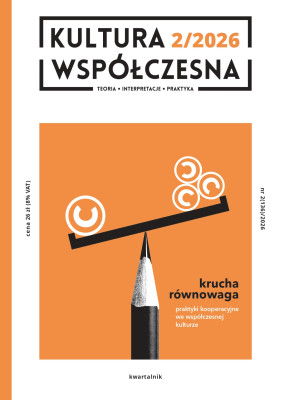
Table of contents
A delicate balance
doi.org/10.26112/kw.2026.136.01
doi.org/10.26112/kw.2026.136.02
This article offers a multifaceted analysis of the social dimension of literature as an important segment of global culture. The authors argue that culture is a world-making process founded on communication and cooperation. They analyse various levels of cooperation involved in the production and circulation of literary texts, highlighting the fact that collective authorship has characterised cultural texts from antiquity to the present day. Particular attention is paid to reception processes where readers become co-creators of meaning by interpreting textual signals through their own experience. The turn of the 20th and 21st centuries is identified as a pivotal moment in the transformation of literary culture driven by the development of the internet, social media and artificial intelligence. The increasing networked nature of communication has blurred the traditional boundaries between the roles of author, publisher and reader. Recipients frequently assume the role of producers, which results in the simultaneous and continuous production and consumption of content in digital environments. Fan fiction and social media beta reading provide notable examples of practices in which the distinction between sender and receiver becomes increasingly fluid.
Key words: popular literature, fantasy literature, literary communication, promotional communication in the arts sector
Bibliography
Antonik, Dominik. Autor jako marka. Literatura w kulturze audiowizualnej społeczeństwa informacyjnego. Kraków: Universitas, 2014.
Bruns, Axel. Blogs, Wikipedia, Second Life, and Beyond: From Production to Produsage. New York: Peter Lang, 2008.
Castells, Manuel. Communication Power. New York: Oxford University Press, 2009.
Gustowski, Wojciech. Marka pisarza. Definiowanie, marketing, komunikacja. Gdynia: Wydawnictwo Zaczytani, 2025.
Harari, Yuval N. Nexus. Krótka historia informacji. Od epoki kamienia do sztucznej inteligencji. Tłum. Justyn Hunia. Kraków: Wydawnictwo Literackie, 2004.
Lachman, Magdalena. „Okładkowy stan posiadania (w literaturze najnowszej)”. Teksty Drugie 6 (2012).
Łastowiecki, Janusz. „Literatura jako mem? Komunikacja kulturowa w epoce produsera na przykładzie Wierszy Mateusza Morawieckiego pisanych w Excelu”. Kultura. Media. Teologia 63 (2025).
Premkumar, Bindu. „The impact of artificial intelligence on literary creation and criticism: Emerging trends and implications”. International Journal of Language, Literature and Culture 4, 4 (2024). https://aipublications.com/uploads/issue_files/5IJLLC-AUG20241-TheImpact.pdf.
Pysz, Robert. „Publiczność literacka 2.0 – rekonesans”. Media i Społeczeństwo 1 (2011).
Stępień, Tomasz. „Tekst okładki”. W: Dzieło literackie i książka w kulturze, red. Ireneusz Opacki, Bożena Mazurkowa. Katowice: Wydawnictwo UŚ, 2002.
Tylor, Edward B. Cywilizacja pierwotna. Badania rozwoju mitologii, filozofii, wiary, mowy, sztuki i zwyczajów. T. 1. Tłum. Zofia Kowerska. Oprac. Jan Karłowicz. Warszawa: Wydawnictwo „Głosu”, 1896.
Żółkiewski, Stefan. Kultura literacka 1918–1932. Wrocław: Ossolineum, 1973.
Żółkiewski, Stefan. Kultura. Socjologia. Semiotyka literacka. Studia. Warszawa: Państwowy Instytut Wydawniczy, 1979.
Żółkiewski, Stefan. Wiedza o kulturze literackiej. Główne pojęcia. Wrocław: Wiedza Powszechna, 1980.
doi.org/10.26112/kw.2026.136.03
This article presents a theoretical and empirical analysis of the role of collaborative artificial intelligence (AI) in the creation of contemporary cultural texts. The authors propose a model of the creative agency continuum alongside a four-level typology of collaboration, ranging from creative augmentation through dialogic and generative co-authorship to autonomous AI agency. The typology is intended as a heuristic device for describing the dynamic configurations of human–non-human co-creation rather than as a fixed taxonomy. The theoretical framework integrates actor-network theory, posthumanist theories of the text, Boden’s taxonomy of creativity, Foucault’s concept of the author function, Mollick’s notion of co-intelligence and the five paradoxes of co-creative systems. The analytical section comprises case studies from literature, visual art, music and performance, supplemented by an autoethnographic reflection on academic practice, including work with NotebookLM, the imitation and compilation of authorial styles and pedagogical discussions with students. By juxtaposing these perspectives with empirical data on the perceptions and preferences of both creators and audiences, the article conceptualises authorship as the configuration of networks of agency and the curation of generative processes.
Key words: collaborative AI, authorship, co-intelligence, digital literature
Bibliography
Allado-McDowell, K. Pharmako-AI. London: Ignota Books, 2020.
Boden, Margaret. The Creative Mind: Myths and Mechanisms. Wyd. 2. London: Routledge, 2024.
Bourdieu, Pierre. Reguły sztuki. Geneza i struktura pola literackiego. Tłum. Andrzej Zawadzki. Kraków: Universitas, 2007.
Colton, Simon, Geraint A. Wiggins. „Computational creativity: The final frontier?”. W: ECAI 2012: 20th European Conference on Artificial Intelligence. Frontiers in Artificial Intelligence and Applications. T. 242. Amsterdam: IOS Press, 2012.
Foucault, Michel. „Co to jest autor?”. W: Powiedziane, napisane. Szaleństwo i literatura. Tłum. Michał P. Markowski. Warszawa: Aletheia, 1999.
Garwol, Katarzyna. „AI w sztuce – czy artyści będą potrzebni? Studium na przykładzie opinii studentów kierunku sztuki wizualne Uniwersytetu Rzeszowskiego”. Media i Społeczeństwo 21 (2024).
Goodfellow, Paul. „The distributed authorship of art in the age of AI”. Arts 13, 5 (2024).
Hayles, N. Katherine. Writing Machines. Cambridge MA: MIT Press, 2002.
Latour, Bruno. Splatając na nowo to, co społeczne. Wprowadzenie do teorii aktora-sieci. Tłum. Aleksandra Derra, Krzysztof Abriszewski. Kraków: Universitas, 2010.
Liu, Yuchang, Yongzhong Yang, Haoran Xu. „From humans to AI: Understanding why AI is perceived as the preferred co-creation partner”. Frontiers in Psychology 16 (2025).
Mollick, Ethan. Co-Intelligence: Living and Working with AI. New York: Portfolio, 2024.
Salma, Zainab, Raquel Hijón-Neira, Celeste Pizarro. „Designing co-creative systems: Five paradoxes in human – AI collaboration”. Information 16, 10 (2025).
Van Hees, Jules, Tijl Grootswagers, Genevieve L. Quek, Manuel Varlet. „Human perception of art in the age of artificial intelligence”. Frontiers in Psychology 15 (2025).
Vara, Vauhini. „Ghosts”. Beliver Magazine, 9 sierpnia 2021. https://www.thebeliever.net/ghosts/.
Vara, Vauhini. Searches. New York: Pantheon, 2025.
doi.org/10.26112/kw.2026.136.04
This article examines the phenomenon of secretaryship as a distinctive yet insufficiently explored form of participation in creative processes. It draws on the narratives of Agnieszka Kosińska and Michał Rusinek, the respective secretaries of Wisława Szymborska and Czesław Miłosz, as presented in the books Miłosz w Krakowie [‘Miłosz in Kraków’] and Nic zwyczajnego. O Wisławie Szymborskiej [‘Wisława Szymborska: Nothing of the Ordinary’]. By analysing these testimonies in the context of autopoiesis (research by Mateusz Antoniuk and Magdalena Popiel) and Jack Stillinger’s concept of literary collaboration, the article demonstrates that the creation of a literary work is a profoundly social process involving numerous participants. This study of secretarial practices – including correspondence management, organisation of working time and mediation of contacts with the literary milieu – reveals the mechanisms through which a writer’s everyday life is constructed and connected to the circulation of texts in culture. The article proposes that literary secretaryship should be understood as a collaborative practice that co-creates the conditions necessary for literary production. A literary secretary emerges as a liminal figure operating at the intersection of creative activity and the institutional infrastructure of literature. Although often discreet and largely invisible, this role proves essential to the functioning of writers in the literary field.
Key words: Miłosz, Szymborska, literary secretary, collaboration, creative processes
Bibliography
Antoniuk, Mateusz. „(Somo/Topo) Narracje autopoietyczne: podmiot tworzący (jako ciało w sieci przedmiotów)”. Ruch Literacki 64, 3 (2023).
Bryant, John. Płynny tekst. Teoria zmienności tekstów i edytorstwa w dobie książki i ekranu. Tłum. Łukasz Cybulski. Warszawa: Wydawnictwo Instytutu Badań Literackich PAN, 2021.
Donin, Nicolas, Daniel Ferrer. „Autor(-rzy) i aktorzy genezy”. Wielogłos 39, 1 (2019).
Eckermann, Johann P. Rozmowy z Goethem. Tłum. Krzysztof Radziwiłł, Janina Zeltzer. Warszawa: Państwowy Instytut Wydawniczy, 1960.
Hołówka, Teresa. Myślenie potoczne. Warszawa: Państwowy Instytut Wydawniczy, 1986.
Kiślak, Elżbieta. „Niedźwiedź z bliska jak żywy”. Teksty Drugie 2 (2016).
Kosińska, Agnieszka. Miłosz w Krakowie. Kraków: Znak, 2015.
Popiel, Magdalena. Świat artysty. Modernistyczne estetyki tworzenia. Kraków: Universitas, 2018.
Rusinek, Michał. Nic zwyczajnego. O Wisławie Szymborskiej. Kraków: Znak, 2016.
Sennett, Richard. Razem. Rytuały, zalety i zasady współpracy. Tłum. Jan Dzierzgowski. Warszawa: Wydawnictwo Muza, 2013.
Stillinger, Jack. Multiple Authorship and the Myth of Solitary Genius. New York: Oxford University Press, 1991.
doi.org/10.26112/kw.2026.136.05
This article analyses the activities of the Urban Workshop in Gliwice, Poland, as an example of a municipal creative cooperative operating in the makerspace model and developing in the conditions of organisational, financial and relational uncertainty. It addresses the question of how grassroots communities functioning without permanent institutional guarantees develop the capacity to respond to crises and sustain organisational continuity. The article explores the concept of social resilience, approaching it not as an outcome of structural stability but as a process embedded in relationships, locality and practices of bottom-up collaborations. The analysis is based on a qualitative case study involving interviews with members of the association and observations of its organisational and relational practices. The findings demonstrate that the resilience of the Urban Workshop stems not from the stability of its formal structures but from relational agility, adaptability and practices of sharing infrastructure, knowledge and responsibility. The article also highlights the paradoxical nature of such communities: their greatest asset lies in the people and relationships that are vital for the community’s existence; however, these same factors may also become sources of tension, vulnerability and internal crisis.
Key words: city, education, cooperation, maker movement
Bibliography
Aronson, Elliot. Człowiek – istota społeczna. Tłum. Józef Radzicki. Warszawa: Wydawnictwo Naukowe PWN, 2011.
Bauman, Zygmunt. Ponowoczesność jako źródło cierpień. Warszawa: Wydawnictwo Sic!, 2000.
Berkes, Fikret, Helen Ross. „Community resilience: Toward an integrated approach”. Society & Natural Resources 26, 1 (2013).
Eliade, Mircea. Mit wiecznego powrotu. Tłum. Krzysztof Kocjan. Warszawa: Wydawnictwo KR, 1998.
Florida, Richard. Narodziny klasy kreatywnej. Tłum. Tomasz Krzyżanowski, Michał Penkala. Warszawa: Narodowe Centrum Kultury, 2010.
Gądecki, Jacek, Bartosz Piziak. Przestrzenie kreatywno-warsztatowe. Makerspace’y, fab laby i warsztaty w przestrzeniach polskich miastach. Warszawa: Instytut Rozwoju Miast i Regionów, 2021.
Gąsior, Wojtek, Paweł Sielczak. Raport: Badanie polskich pracowni mejkerskich. Warszawa: Fundacja Stocznia, 2022.
Giddens, Anthony. Nowoczesność i tożsamość. „Ja” i społeczeństwo w epoce późnej nowoczesności. Tłum. Alina Szulżycka. Warszawa: Wydawnictwo Naukowe PWN, 2010.
Gliński, Piotr. Style działań organizacji pozarządowych w Polsce. Grupy interesów czy pożytku publicznego?. Warszawa: Wydawnictwo Instytutu Filozofii i Socjologii PAN, 2006.
Kotlarska-Michalska, Anna, Przemysław Nosal, red., Zaradność społeczna. Współczesne przejawy i ograniczenia. Poznań: Wydawnictwo Naukowe Wydziału Nauk Społecznych UAM, 2016.
Krajewski, Marek, red., Handmade. Praca rąk w postindustrialnej rzeczywistości. Warszawa: Fundacja Nowej Kultury Bęc Zmiana, 2010.
Krajewski, Marek. „Incydenty. Badając gęste społeczeństwo”. Studia Socjologiczne 221, 2 (2016).
Nosal, Przemysław, Maciej Frąckowiak. „Zaradność społeczna: od ujęcia egzystencjalnego do egzystencjalistycznego?”. Przegląd Socjologiczny 74, 1 (2025).
Stępka, Maciej. „Rezyliencja jako paradygmat bezpieczeństwa w czasach przewlekłych kryzysów”. Przegląd Politologiczny 2 (2021).
Tönnies, Ferdinand. Wspólnota i stowarzyszenie. Tłum. Małgorzata Łukasiewicz. Warszawa: Wydawnictwo Naukowe PWN, 2008.
doi.org/10.26112/kw.2026.136.06
This article examines the significance of collectivism, in its various forms, in contemporary Polish literary life conventionally understood as the period since 1989 (or more broadly since late 1980s). Collectivism is generally defined as a creative activity involving multiple individuals. Rather than be limited to the production of multi-authored texts it also encompasses initiatives that promote, publicise and integrate writing communities. The argument is illustrated through an analysis of the activities of artists associated with the so-called ‘bruLion’ generation and authors who shared similar artistic priorities. The article explores what makes collaborative work attractive to contemporary writers, the models of creativity, patronage and tradition upon which its dominant forms draw, and the advantages and limitations of these practices. It also offers several broader observations that may contribute to future research on collectivism in the arts, a field that has thus far received relatively limited systematic scholarly attention.
Key words: collectivism, co-authorship, Polish literature after 1989, literary life, the ‘bruLion’ generation
Bibliography
Baumbach, Manuel, red., Co-authorship. Collaboration, Multiple Authorship and the Melding of Minds in Literature, Arts and Sciences. Papers in Honour of Glenn W. Most. Leiden: Brill, 2025.
Eipeldauer, Heike, Franz Thalmair, red., Collaborations, 2.07–6.11.2022. Vienna: mumok – Museum moderner Kunst Stiftung Ludwig Wien, 2022.
Gazda, Grzegorz. „Awangarda”. W: Encyklopedia kultury polskiej XX wieku: Od awangardy do postmodernizmu, red. Grzegorz Dziamski. Warszawa: Instytut Kultury, 1996.
Klejnocki, Jarosław, Jerzy Sosnowski. Chwilowe zawieszenie broni. O twórczości tzw. pokolenia „bruLionu” (1986–1996). Warszawa: Wydawnictwo Sic!, 1996.
Kluszczyński, Ryszard W. Sztuka interaktywna. Od dzieła-instrumentu do interaktywnego spektaklu. Warszawa: Wydawnictwa Akademickie i Profesjonalne, 2010.
Kobus, Aldona. Autorstwo. Urynkowienie literatury i fantazmat podmiotu autorskiego. Toruń: Wydawnictwo Naukowe UMK, 2021.
Lachman, Magdalena. Jak (nie) być pisarzem. Literatura we współczesnej przestrzeni komunikacyjnej. Warszawa: Wydawnictwo Instytutu Badań Literackich PAN – Wydawnictwo UŁ, 2019.
Stańczyk, Xawery. Macie swoją kulturę. Kultura alternatywna w Polsce 1978–1996. Warszawa: Narodowe Centrum Kultury, 2018.
Stillinger, Jack. Multiple Authorship and the Myth of Solitary Genius. New York: Oxford University Press, 1991.
Świetlicki, Marcin. Nieprzysiadalność. Autobiografia. Rozmawia Rafał Księżyk. Kraków: Wydawnictwo Literackie, 2017.
Wieczorek, Marcin. „bruLion”. Instrukcja obsługi. Kraków: Korporacja Ha!art, 2005.
Zawodniak, Mariusz. „Zespołowe metody tworzenia”. W: Słownik realizmu socjalistycznego, red. Zdzisław Łapiński, Wojciech Tomasik. Kraków: Universitas, 2004.
Resilience and resistance
doi.org/10.26112/kw.2026.136.07
This article addresses the marginal place of artistic groups in the sociology of art by proposing the concept of a longue durée group as an analytical tool for examining long-term forms of artistic co-presence in the field of culture. It starts with a critique of the dominant Western figure of the artist as an autonomous genius, which obscures the relational dimensions of artistic practice. The analysis of collaborative mechanisms and practices sustaining group continuity is based on the case of KrakArt, a California-based artistic collective active since the 1980s. The theoretical framework draws on Étienne Wenger’s concept of communities of practice and the biographically oriented sociology of art. The empirical material consists of in-depth individual interviews conducted with long-standing members of the group between 2023 and 2025. The analysis reconstructs the emergence of an émigré artistic community whose cohesion has been shaped not by a shared aesthetic programme but by relational continuity, shared history and the need for identity-based embeddedness in an otherwise unfamiliar social and cultural environment. The findings suggest that the collective’s longevity depends on a mode of practice capable of reconciling individual artistic autonomy with the dense relational fabric of communal life.
Key words: KrakArt, sociology of art, communities of practice, artistic emigration, collective
Bibliography
Becker, Howard S. Światy sztuki. Tłum. Paweł Tomanek. Warszawa: Narodowe Centrum Kultury, 2025.
Bojko, Szymon. Z polskim rodowodem: Artyści polscy i amerykańscy polskiego pochodzenia w sztuce Stanów Zjednoczonych w latach 1900–1980. Toruń: Oficyna Wydawnicza Kucharski, 2007.
Bourdieu Pierre. Reguły sztuki: Geneza i struktura pola literackiego. Tłum. Andrzej Zawadzki. Kraków: Universitas, 2001.
Danto, Arthur C. „The artworld”. The Journal of Philosophy 19, 61 (1964).
Denzin, Norman K., Yvonna S. Lincoln, red., Metody badań jakościowych. T. 1–2. Tłum. Krzysztof Podemski. Warszawa: Wydawnictwo Naukowe PWN, 2009.
Dickie, George. Art and the Aesthetic: An Institutional Analysis. Ithaca NY: Cornell University Press, 1974.
Ferenc, Tomasz. Artysta jako Obcy. Socjologiczne studium artystów polskich na emigracji. Łódź: Wydawnictwo UŁ, Wydawnictwo Biblioteki PWSFTiT, 2012.
Flick, Uwe. Projektowanie badania jakościowego. Tłum. Paweł Tomanek. Warszawa: Wydawnictwo Naukowe PWN, 2011.
Mamzer, Hanna. Tożsamość w podróży. Wielokulturowość a kształtowanie tożsamości jednostki. Poznań: Wydawnictwo Naukowe UAM, 2002.
Niedźwiedzki, Dariusz. Migracje i tożsamość. Od teorii do analizy przypadku. Kraków: Zakład Wydawniczy Nomos, 2010.
Sienkiewicz, Jan W. „KrakArt Group z Kalifornii. Z badań nad sztuką polską w amerykańskiej Ameryce”. W: Polacy w Ameryce. T. II. Red. Maciej Kordas, Karol Kucharski, Iwona Stefaniak. Warka: Muzeum im. Kazimierza Pułaskiego, 2021.
Szyszko-Bohusz, Marian. „Problemy polskiej plastyki na emigracji”. W: Sztuka polska w Wielkiej Brytanii 1940–2000, red. Mirosław A. Supruniuk. Toruń: Wydawnictwo UMK, 2006.
Wenger, Étienne. Communities of Practice: Learning, Meaning, and Identity. Cambridge: Cambridge University Press, 1998.
Włodarek, Jan, Marek Ziółkowski, red., Metoda biograficzna w socjologii. Warszawa: Państwowe Wydawnictwo Naukowe, 1990.
Wolff, Janet. The Social Production of Art. London: Macmillan, 1981.
doi.org/10.26112/kw.2026.136.08
This article examines the role of the playwright in Polish contemporary theatre, a position that has become firmly established after approximately three decades of its presence on the Polish stage. Initially regarded as an imported and somewhat alien element in the local landscape, the playwright is now a familiar figure in most theatres. Nevertheless, the role itself remains subject to differing interpretations and lacks a universally accepted definition. This article investigates the factors that have contributed to the growing prominence of playwrights in recent years, focusing on their role in advancing collective modes of creation and the democratisation of creative processes in theatre. It analyses the definitions and traditions associated with playwrighting, including the German tradition dating back to the 18th century and the American tradition that emerged during the 1960s and 1970s. These considerations are placed in the broader context of transformations in European theatre since the Great Reform of the Theatre, as well as changes in Polish theatre following the political transition of 1989. The article explores how these developments have shaped contemporary dramaturgy and strengthened the role of the playwright in modern theatre practice.
Key words: playwright, dramaturgy, Polish contemporary theatre, collective, stage writing
Bibliography
Baluch, Wojciech. „Dramaturgia”. W: Performatyka. Terytoria, red. Dariusz Kosiński, Ewa Bal. Kraków: Wydawnictwo UJ, 2017.
Gańczarczyk, Iga. „Truizmy. O dramaturgii”. Didaskalia 151–152 (2019).
Guderian-Czaplińska, Ewa, Stanisław Godlewski, red., Kolektywy teatralne, artystyczne i badawcze. Warszawa: Instytut Teatralny im. Zbigniewa Raszewskiego, 2018.
Kosiński, Dariusz. Performatyka. W(y)prowadzenia. Kraków: Wydawnictwo UJ, 2016.
Krakowska, Joanna. „Przesiedleni. Wstęp”. W: Transfer! Teksty dla teatru, red. Joanna Krakowska. Warszawa: Wydawnictwo Krytyki Politycznej, 2015.
Krakowska, Joanna. „Transfer!, czyli Archiwum”. Dialog 12 (2017). https://www.dialog-pismo.pl/w-numerach/transfer-czyli-archiwum.
Kwaśniewska, Monika. „Kolektyw. Perspektywa aktorów”. Dialog 11 (2018). https://www.dialog-pismo.pl/w-numerach/kolektyw-perspektywa-aktorow.
Lehmann, Hans-Thies. Teatr postdramatyczny. Tłum. Dorota Sajewska, Małgorzata Sugiera. Kraków: Księgarnia Akademicka, 2009.
Piscator, Erwin. Teatr polityczny. Tłum. Roman Szydłowski. Warszawa: Wydawnictwa Artystyczne i Filmowe, 1983.
Puzyna, Konstanty. „Pisać na scenie”. W: Konstanty Puzyna. Burzliwa pogoda. Warszawa: Państwowy Instytut Wydawniczy, 1971.
doi.org/10.26112/kw.2026.136.09
This article examines the contemporary Atari 8-bit demoscene, with particular attention to the period between 2024 and 2026. As both researchers and active participants in the demoscene, the authors employ qualitative methods from digital ethnography: participant observation, field diaries, informal interviews and the analysis of event documentation. One of the central research questions concerns the extent to which contemporary demoparties function as sites for preserving and transmitting tradition or spaces of experimentation and redefinition of demoscene values. The article focuses on processes of professionalisation and partial institutionalisation in the Atari 8-bit demoscene, as reflected in event organisation, technical infrastructure, communication practices and relationships with institutions and sponsors. The analysis centres on three major Polish events: Silly Venture, Last Party and Lost Party. Empirical observations are discussed in a broader cultural context that considers both the recognition of the demoscene as an element of intangible cultural heritage and the growing body of academic research devoted to this phenomenon.
Key words: demoscene, party, intangible cultural heritage, Atari 8-bit, eventisation
Bibliography
Borzyskowski, George. The Hacker Demo Scene and Its Cultural Artefacts. Cybermind Conference 1996.
Dramczyk, Bartek. Lokalny fenomen #Demoscena. Korporacja Ha!art. https://web.archive.org/web/20170107075357/https://ha.art.pl/projekty/felietony/4986-lokalny-fenomen-demoscena-2.html.
Furman, Ivo, Arda Erdikmen. „The demoscene: from digital subculture to UNESCO intangible cultural heritage”. International Journal of Heritage Studies 32, 3 (2025).
Han, Byung-Chul. Duch nadziei i inne eseje. Tłum. Rafał Pokrywka. Warszawa: Wydawnictwo Krytyki Politycznej, 2025.
Herman, Łukasz. „Demoscena – od potrzeby autoekspresji do sztuki”. K&A Plus (2025).
Huhtamo, Erkki, Jussi Parikka. „Introduction: an archaeology of media archaeology”. W: Media Archaeology: Approaches, Applications, and Implications, red. Erkki Huhtamo, Jussi Parikka. Berkeley: University of California Press, 2011.
Marecki, Piotr. Gatunki cyfrowe. Instrukcja obsługi. Kraków: Wydawnictwo UJ, 2018.
Reunanen, Markku, Patryk Wasiak, Daniel Botz. „Crack intros: Piracy, creativity, and communication”. International Journal of Communication 9 (2015).
Wasiak, Patryk. „Playing and copying: social practices of home computer users in Poland during the 1980s”. W: Hacking Europe: From Computer Cultures to Demoscenes, red. Gerard Alberts, Ruth Oldenziel. London: Springer, 2014.
Ziembik, Krzysztof. „Przedmowa”. W: Wiesław Migut. Atari Basic. Magdalenka: Retronics, 2018.
doi.org/10.26112/kw.2026.136.10
This article studies ephemeral media as a space in which the categories of authorship and cooperation are transformed under the conditions of the platform-based infrastructure. It argues that cooperation in digital environments extends beyond interpersonal relationships to include interfaces, formats and recommendation algorithms. Drawing on Lev Manovich’s concept of modularity, Taina Bucher’s notion of algorithmic imaginary and classical theories of authorship as a discursive function (Foucault, Barthes), the author demonstrates that contemporary co-authorship is both procedural and contingent. Online platform publications are not closed creative acts but rather elements in the dynamic circulation of content, with agency dispersed between users and technological systems. Particular attention is paid to TikTok as a model ephemeral environment where sounds, filters, formats and visibility mechanisms co-organise the creative processes. In this context, ephemerality refers not only to the transience of content but also to the organisation of creativity as an event-based experience. The concept of fragile algorithmic cooperation is proposed as a framework for understanding the tensions among authorial autonomy, platform logic and the algorithmic distribution of visibility. The article discusses ephemeral media in the context of broader transformations in contemporary platform culture where authorship increasingly assumes a relational, processual and infrastructural character.
Key words: ephemeral media, algorithmic co-authorship, platform infrastructure, interface, artificial intelligence (AI)
Bibliography
Abidin, Crystal, Mart Ots. „Influencers tell all? Unravelling authenticity and credibility in a brand scandal”. W: Blurring the Lines: Market-driven and Democracy-driven Freedom of Expression, red. Maria Edström, Andrew T. Kenyon, Eva-Maria Svensson. Göteborg: Nordicom, 2016.
Barthes, Roland. „Śmierć autora”. Tłum. Michał P. Markowski. Teksty Drugie 1–2 (1999).
Bucher, Taina. If… Then: Algorithmic Power and Politics. New York: Oxford University Press, 2018.
Bucher, Taina. „The algorithmic imaginary: Exploring the ordinary affects of Facebook algorithms”. Information, Communication & Society 20, 1 (2017).
Foucault, Michel. Powiedziane, napisane. Szaleństwo i literatura. Wyb. i oprac. Tomasz Komendant. Tłum. Bogdan Banasiak, Tadeusz Komendant, Małgorzata Kwietniewska, Ariadna Lewańska, Michał P. Markowski, Paweł Pieniążek. Warszawa: Wydawnictwo Aletheia, 1999.
Galloway, Alexander R. The Interface Effect. Cambridge: Polity Press, 2012.
Manovich, Lev. Instagram and Contemporary Image. Manovich.net. San Diego, 2017.
Manovich, Lev. Język nowych mediów. Tłum. Piotr Cypryański. Warszawa: Wydawnictwa Akademickie i Profesjonalne, 2006.
Sennett, Richard. Razem. Rytuały, zalety i zasady współpracy. Tłum. Jan Dzierzgowski. Warszawa: Wydawnictwo Muza, 2013.
Stillinger, Jack. Multiple Authorship and the Myth of Solitary Genius. New York: Oxford University Press, 1991.
Van Dijck, José, Thomas Poell, Martijn de Waal. The Platform Society: Public Values in a Connective World. Oxford: Oxford University Press, 2018.
Williams, Raymond. Television: Technology and Cultural Form. New York: Schocken Books, 1974.
doi.org/10.26112/kw.2026.136.11
This article examines the urban festival as an organisational and relational process rather than merely a cultural event or symbolic product. It opens with a critique of dominant research approaches focused on festival audiences and impacts while overlooking the internal organisation processes. The aim of the study is to reconstruct the festival as a network of relations involving both human and non-human actors and to conceptualise festival authorship as a dispersed phenomenon. The article presents a qualitative case study based on the Actor-Network Theory (ANT). The analysis draws on the triangulation of several research methods, including in-depth interviews with organisers of the East of Culture-Different Sounds festival, questionnaire data collected from volunteers and an analysis of organisational materials. The findings indicate that the authorship of a publicly funded festival is distributed across a network of actors rather than concentrated in a single individual or institution. Volunteering emerges as an ontological condition of the festival’s existence and the city as one of the agents behind the event’s form and development. The analysis further demonstrates that agency in the organisation of the festival is distributed among individuals, institutions, infrastructures, procedures and urban space. The article contributes to festival studies by shifting attention from the outcomes of cultural events to the production processes. It also reveals the value of the ANT perspective as a useful complement to established approaches in event studies for analysing contemporary cultural events.
Key words: urban festival, ANT, dispersed authorship, volunteering, city
Bibliography
Dostlieva, Lia, Bogna Kociołowicz-Wiśniewska, Waldemar Kuligowski, Natalia Nowińska-Antoniewicz, Marcin Poprawski, Agnieszka Szymkiewicz. Uwierz w festiwal. Aksjonormatywne wymiary współczesnych festiwali muzycznych w Polsce. Warszawa: Instytut Wydawniczy Książka i Prasa, 2022.
Głuchowski, Przemysław. „Zeitgeist festiwali miejskich w Polsce. Symbioza oddolnego aktywizmu, polityki kulturalnej i budowania tożsamości na przykładzie Lublina”. Konteksty Społeczne | Social Contexts 12, 1 (2024).
Kaczmarek, Olga. „Ciemna strona festiwali oczami wolontariusza”. Czas Kultury 4 (2013).
Kołtun, Aleksandra, Marcin Lipowski, Ilona Bondos, Andrzej Stawicki. Raport końcowy. Wpływ festiwali na rozwój miasta. Lublin: Warsztaty Kultury, 2017.
Kołtun, Aleksandra, Anastazja Szuła. Raport z badań publiczności festiwalu Wschód Kultury – Inne Brzmienia Art’n’Music Festival. Lublin: Warsztaty Kultury, 2025.
Kuligowski, Waldemar. „Ludzie, sztuka, pieniądze. Festiwalizacja w Polsce”. Czas Kultury 4 (2013).
Latour, Bruno. Splatając na nowo to, co społeczne. Wprowadzenie do teorii aktora-sieci. Tłum. Aleksandra Derra, Krzysztof Abriszewski. Kraków: Universitas, 2010.
Poprawski, Marcin, Alicja Jakubowska, Piotr Firych, Michał Mękarski, Magdalena Brodniewicz, Piotr Landsberg, Przemysław Kieliszewski, Roksana Kędzierska, Ewa Kłosiewicz, Joanna Michalczuk, Klaudia Zielińska, Justyna Gorgoń, Kamila Węglarska, Filip Wróblewski. Oddziaływanie festiwali na polskie miasta. Studium kompetencji kadr sektora kultury oraz synergii międzysektorowej. Raport z projektu badawczego. Poznań: Związek Miast Polskich, 2015.
Smith, Andrew, Guy Osborn, Bernadette Quinn, red., Festivals and the City. The Contested Geographies of Urban Events. London: University of Westminster Press, 2022.
Stillinger, Jack. Multiple Authorship and the Myth of Solitary Genius. New York: Oxford University Press, 1991.
Szlendak, Tomasz, Krzysztof Olechnicki. Nowe praktyki kulturowe Polaków. Megaceremoniały i subświaty. Warszawa: Wydawnictwo Naukowe PWN, 2017.
Wojciechowska, Agnieszka, Aleksandra Kołtun. „Czy festiwal może być etyczny? Lublin – Miasto Etycznych Festiwali”. Rocznik Kultury Polskiej (2025).
Culture for the future: A debate
doi.org/10.26112/kw.2026.136.12
Memory
doi.org/10.26112/kw.2026.136.13
Reviews and discussions
doi.org/10.26112/kw.2026.136.14
Review of: Nawrocki, Maciej. „Sarmatyzm”. Historia pojęcia. Toruń: Wydawnictwo Naukowe UMK, 2024.
Key words: sarmatism, conceptual history, history of ideas, modernity
Bibliography
Adorno, Theodor. Teoria estetyczna. Tłum. Krystyna Krzemieniowa. Warszawa: Wydawnictwo Naukowe PWN, 1994.
Bohuszewicz, Paweł. „Pożytki z prawicowego neosarmatyzmu. (Nie-prawicowa) obrona Krzysztofa Koehlera”. W: Przeszłość we współczesnej narracji kulturowej. Studia i szkice kulturoznawcze, t. 1, red. Piotr Biliński. Kraków: Wydawnictwo UJ, 2011.
Czapliński, Przemysław. Resztki nowoczesności. Dwa studia o literaturze i życiu. Kraków: Wydawnictwo Literackie, 2011.
Koehler, Krzysztof. „Sarmatia defensa”. Arcana 1 (1996).
Koehler, Krzysztof. „Towarzystwo pożytku czy pożytek towarzystwa? Kilka uwag o szlacheckim dyskursie republikańskim”. Arcana 4–5 (2006).
Koselleck, Reinhart. Semantyka historyczna. Tłum. Wojciech Kunicki. Poznań: Wydawnictwo Poznańskie, 2001.
Maciejewski, Jerzy. „O «Monitorze», Oświeceniu i Sarmatach”. Arcana 1 (1996).
Parkitny, Maciej. Nowoczesność oświecenia. Studia o literaturze i kulturze polskiej drugiej połowy XVIII wieku. Poznań: Wydawnictwo Naukowe UAM, 2018.
Purchla, Jacek. „Druga fala sarmatyzmu: szlachta w Krakowie w drugiej połowie XIX wieku”. W: Kraków sarmacki: materiały sesji naukowej z okazji Dni Krakowa w roku 1989, red. Wiesław Bieńkowski. Kraków: Wydawnictwo i Drukarnia „Secesja”, 1992.
Sowa, Jan. Fantomowe ciało króla. Peryferyjne zmagania z nowoczesną formą. Kraków: Universitas, 2011.
Szleszyński, Bartłomiej. Przymierzanie kontusza. Henryk Rzewuski i Henryk Sienkiewicz – najwybitniejsi twórcy XIX-wiecznego nurtu sarmackiego. Warszawa: Instytut Badań Literackich PAN, 2007.
„Świat pojęć własnych. Z okazji 30-lecia «Kultury Współczesnej»”. Kultura Współczesna. Teoria, Interpretacje, Praktyka 5, 125 (2023).
Waśko, Andrzej. Romantyczny sarmatyzm: tradycja szlachecka w literaturze polskiej lat 1831–1863. Kraków: Wydawnictwo Arcana, 1995.
Wdowik, Agata. „W poszukiwaniu własnych korzeni – analiza tekstów Krzysztofa Koehlera (oraz Andrzeja Waśki)”. Tekstualia 15, 4 (2008).
doi.org/10.26112/kw.2026.136.15
Review of: Urbanowicz, Piotr. Elektryczny romantyzm. Nauka o elektryczności a literatura i filozofia polska pierwszej połowy XIX wieku. Toruń: Wydawnictwo UMK, 2024.
Key words: Romanticism, science, electricity, modernity, philosophy of nature
Bibliography
Beer, Gillian. Open Fields: Science in Cultural Encounter. Oxford: Clarendon Press, 1996.
Foucault, Michel. Archeologia wiedzy. Tłum. Andrzej Siemek. Warszawa: DeAgostini, 2002.
Górski, Konrad. „Semantyka ognia w praktyce pisarskiej Mickiewicza”. Pamiętnik Literacki 65, 1 (1974).
Kutrzeba, Kacper. Kalekująca nowoczesność a literatura. Dialektyczne przygody u zarania polskiej modernizacji. Toruń: Wydawnictwo UMK, 2022.
Latour, Bruno. Splatając na nowo to, co społeczne. Wprowadzenie do teorii aktora-sieci. Tłum. Aleksandra Derra, Krzysztof Abriszewski. Kraków: Universitas, 2010.
doi.org/10.26112/kw.2026.136.16
Review of: Koprowska, Karolina. Miejsce urodzenia jako uwikłanie. Projekty tożsamościowe w literaturze polskiej i żydowskiej. Warszawa: Wydawnictwo Instytutu Badań Literackich PAN, 2024.
Key words: place of birth, memory studies, peasant literature, Jewish literature
Bibliography
Kobielska, Maria. „Polski impas, polskie uwikłanie: sonda pamięcioznawcza”. W: Sztuka inwencji – Ryszarda Nycza praktykowanie humanistyki: rozmowy, inspiracje, kontynuacje, red. Jerzy Franczak, Tomasz Kunz. Kraków: Wydawnictwo UJ, 2021.
Koprowska, Karolina. Miejsce urodzenia jako uwikłanie. Projekty tożsamościowe w literaturze polskiej i żydowskiej. Warszawa: Wydawnictwo Instytutu Badań Literackich PAN, 2024.
Koprowska, Karolina. „Miejsce urodzenia po Zagładzie w poezji Rejzl Żychlińskiej – w stronę innego projektu tożsamościowego”. Narracje o Zagładzie 5 (2019).
Koprowska, Karolina. „Pamięć – trauma – opowieść. O do-świadczeniu ocalałego z Zagłady”. W: Lelów: miejsce, doświadczenie, pamięć, red. Mirosław Skrzypczyk. Lelów: Wydawnictwo UW, 2016.
Koprowska, Karolina. Postronni? Zagłada w relacjach chłopskich świadków. Kraków: Universitas, 2018.
Koprowska, Karolina. „The bystander complex: The Holocaust in relation to peasant witness”. Tłum. Sean Gasper Bye. Teksty Drugie 1 (2023).
Nycz, Ryszard. Kultura jako czasownik. Sondowanie nowej humanistyki. Warszawa: Wydawnictwo Instytutu Badań Literackich PAN, 2017.
Rothberg, Michael. Pamięć wielokierunkowa. Pamiętanie Zagłady w epoce dekolonizacji. Tłum. Katarzyna Bojarska. Warszawa: Wydawnictwo Instytutu Badań Literackich PAN, 2015.
Rothberg, Michael. The Implicated Subject. Beyond Victims and Perpetrators. Stanford: Stanford University Press, 2019.
Rothberg, Michael. Traumatic Realism: The Demands of Holocaust Representation. Minneapolis: University of Minnesota Press, 2000.